
Flow Diagram #2
Half-cats and wild dogs

In early January 2025, I was in Los Angeles doing research on urban wildlife. The Palisades and Eaton wildfires were burning out of control and I could taste the smoke in the back of my throat every time I went outside. A friend of mine showed me a video clip he had taken a couple of days earlier in his backyard: everything, including his BBQ, deck chairs, and individual blades of grass, were covered in a thick layer of ash, as fine as a gentle dusting of snow.
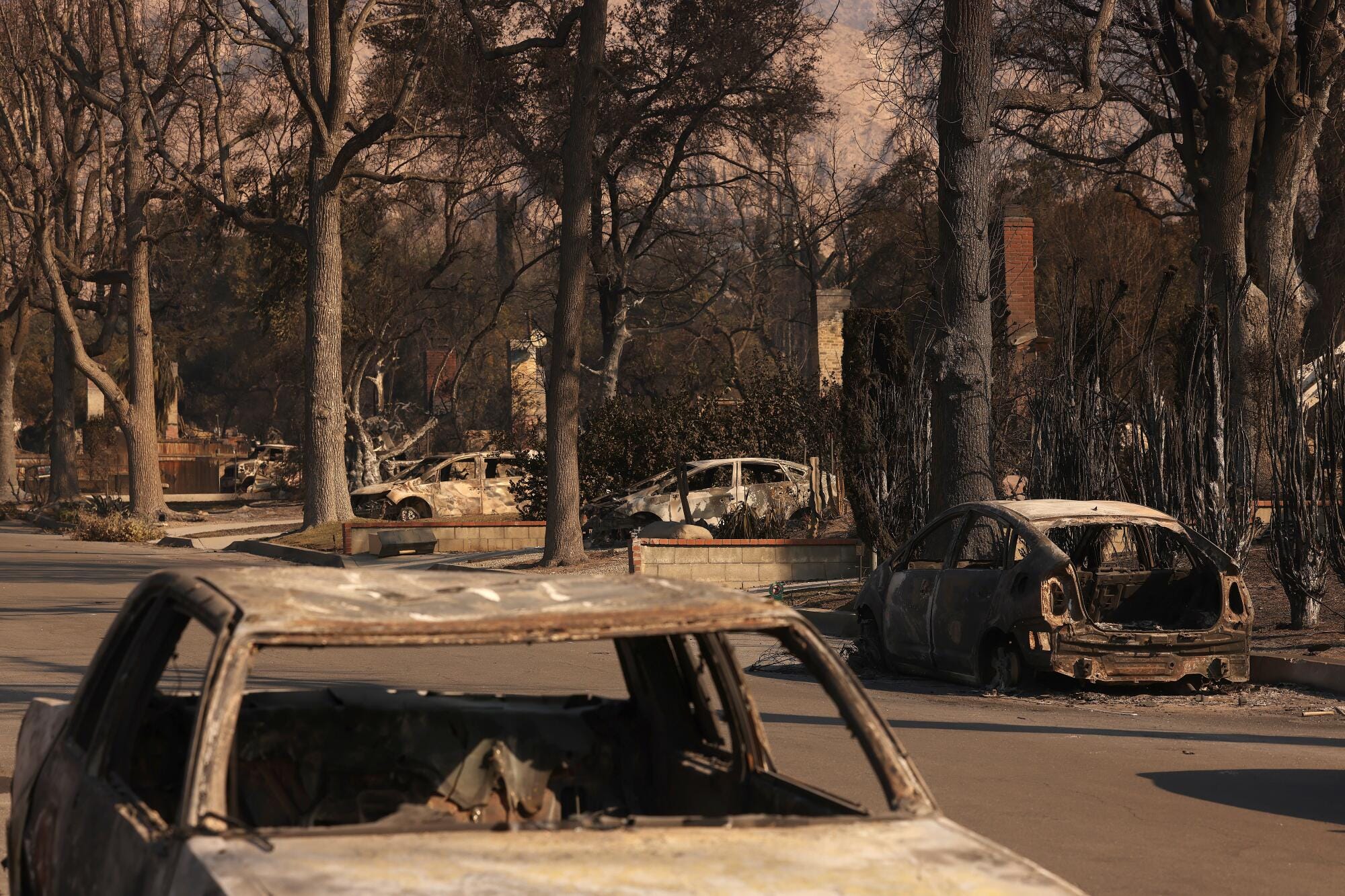
Coverage of the fires was understandably focused on their human impact, with hundreds of thousands of LA residents displaced, 29 people killed, and hundreds of millions in property damage. Whole neighborhoods had been destroyed, including historically Black communities in Altadena on the edge of the Angeles National Forest, a mountainous expanse that’s home to bears, bobcats, mountain lions, deer, skunks, coyotes, and many other beautiful creatures.
It was the coyote that had brought me to LA. For someone interested in synanthropes (aka urban wild animals), the coyote was a bit of an outlier. The most successful urban animals are by and large small and innocuous, and there’s a very good reason for that: as soon as an animal gets too big, it risks a backlash from humans, the world’s apex predator. The exceptions to the rule—like baboons, which are enormous and somewhat terrifying, and have taken over parts of cities in Ethiopia, South Africa, Saudi Arabia, among others—are often highly intelligent and driven by a deep-seated curiosity that leads them to explore new spaces. Coyotes, though, aren’t inherently curious. In fact, they’re among the most neophobic predators that roam cities, meaning they have an inherent and extreme fear of newness. That’s unlike other closely-related members of the Carnivora order like raccoons and skunks, both of which are much more likely to test out new strategies to survive than coyotes. Scientists discovered this through an experiment that required the animals to push down a button in a small hutch to release a food pellet. Raccoons were whizzes at uncovering the trick, and skunks were almost as quick. But of the 6 coyotes that were presented with the contraption, only one dared to press down on the button, and only after 44 nights. In short, coyotes have no business doing well in urban spaces.
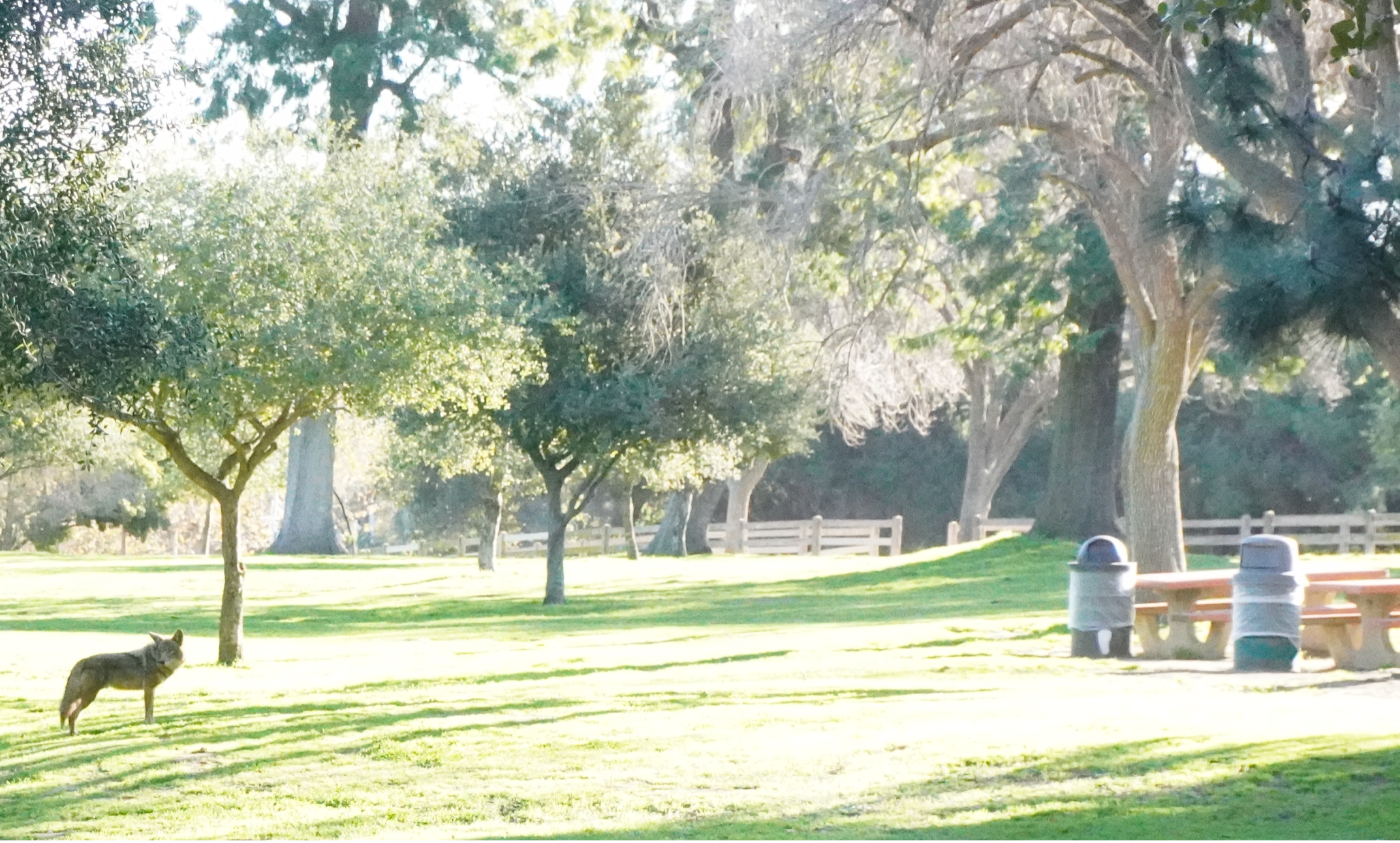
And yet, they’re doing incredibly. Over the past one hundred years, the coyote has expanded its home range at dozens of miles per decade—a remarkable feat for an animal that’s widely hated. In recent years, it’s become a fixture in cities across North America as far apart as Cancún, Toronto, and LA. And while they’re getting better at adapting to living with humans, that doesn’t mean that they’re suddenly being embraced with open arms. In the city of Downey, a suburb of Los Angeles, a local mayor set up ‘Coyotes Out Of Downey,’ a volunteer group tasked with a self-evident mandate and a citizen-powered online map of coyote sightings. To give you a sense of the spirit of the enterprise, COOD was closely modelled on a previous Downey city initiative: GOOD, better known as Gangs Out Of Downey. The message is clear: coyotes are as threatening to the social order as gangs are.

Like many synanthropes, the issue with urban coyotes is less about evil animals roaming our communities, and more about the ways we interact with them. That being said, I can relate to the fear. A few months ago, my partner Miranda went into our backyard in Toronto and found a half-cat, its body from the waist down torn off and presumably eaten. In our neighborhood, the only animals capable of doing something like that (entering our yard unattended, stalking a cat, and eating it) are coyotes. So the idea that these large wild dogs (coyotes, Canis Latrans, are members of the Canidae, the dog family) are benign urban residents isn’t really accurate, though they’re also not the harbingers of death that they’re made out to be in some media stories. Given how much fear they can muster in humans—and knowing how quick to violence humans are when they’re scared—it’s remarkable that coyotes haven’t just relocated into cities but that they’re doing so at ever greater numbers.
The movement of coyotes into cities like LA began in earnest in the 1980s and 1990s, when urban sprawl was transforming vast tracts of farmland, prairie, and forest into planned communities at lightning speed. Within weeks or even days, an open field on the edge of a forest could be fenced-in, torn up, and converted into an ‘enclosure matrix’ of concrete-and-timber townhouses, each with their own fencelines and surrounded by environments cast in the logic of the human mind. Given how neophobic coyotes are, many of them were unable or unwilling to move somewhere new as the world around them came crashing down, which meant that they had to make do in their new surroundings. That basic pattern—coyotes trapped within the rapid remaking of their home ranges into suburbs and cities—drove much of the first wave of urban coyotes. More recently, there’s been a shift. The new wave of urban coyotes isn’t as likely to be trapped by sprawl but instead be drawn towards cities, entering them of their own accord.

When I spoke with Chris Schell, an urban evolutionary biologist, a native of Altadena, and one of the world’s leading experts on urban coyotes, he explained that coyotes are being both pushed and pulled into cities. “Droughts continue to intensify,” he pointed out, “which makes many animals look for more stable access to fresh, clean water. And the best place to find that is in human settlements.” Climate change is pushing the coyotes in. But what about the pull? One of the side effects of fewer reliable water sources in nature, Schell explained, is that species that coyotes prey on are moving into cities. “So now these carnivores are coming down the hill to get their food.”
So the next time you see a coyote wandering your neighborhood (or come across the remnants of its meal), take a moment to appreciate how unlikely it is that this large wild dog has somehow found a niche among humans, a creature that is programmed to despise it. It’s an amazing feat of adaptation, and a sign of how wild our cities are becoming.
A few other thoughts…
If you’re searching for your next Heated Rivalry-level soap opera, look no further than the story of the Liberty Village coyotes in Toronto. This story has it all: a multinational spa company, violent attacks on pets, a city cover-up, a botched report, a citizen’s group that takes matters into its own hands…enjoy.
Last year’s LA wildfires were especially impactful for Black communities in Southern California. Altadena has many historically Black neighborhoods that were reduced to ash, including for Chris Schell, the urban ecologist I mentioned above, whose work on urban wildlife and climate change suddenly became deeply personal after the fires swept through his hometown.
Finally, if you’re enjoying Flow Diagram, please subscribe and tell your friends! Also, I’m on Instagram in case you want to see me slowly discover my social side. Come say hi!